
nuke
-
Posts
144 -
Joined
-
Last visited
-
Days Won
12
Content Type
Profiles
Forums
Gallery
Blogs
Events
Everything posted by nuke
-
You could just learn all the licks in "Steppin Out" on the Beano album and make a career out of just that.
-
Gotta say, Heritage has made some darn pretty gee-tars.
-
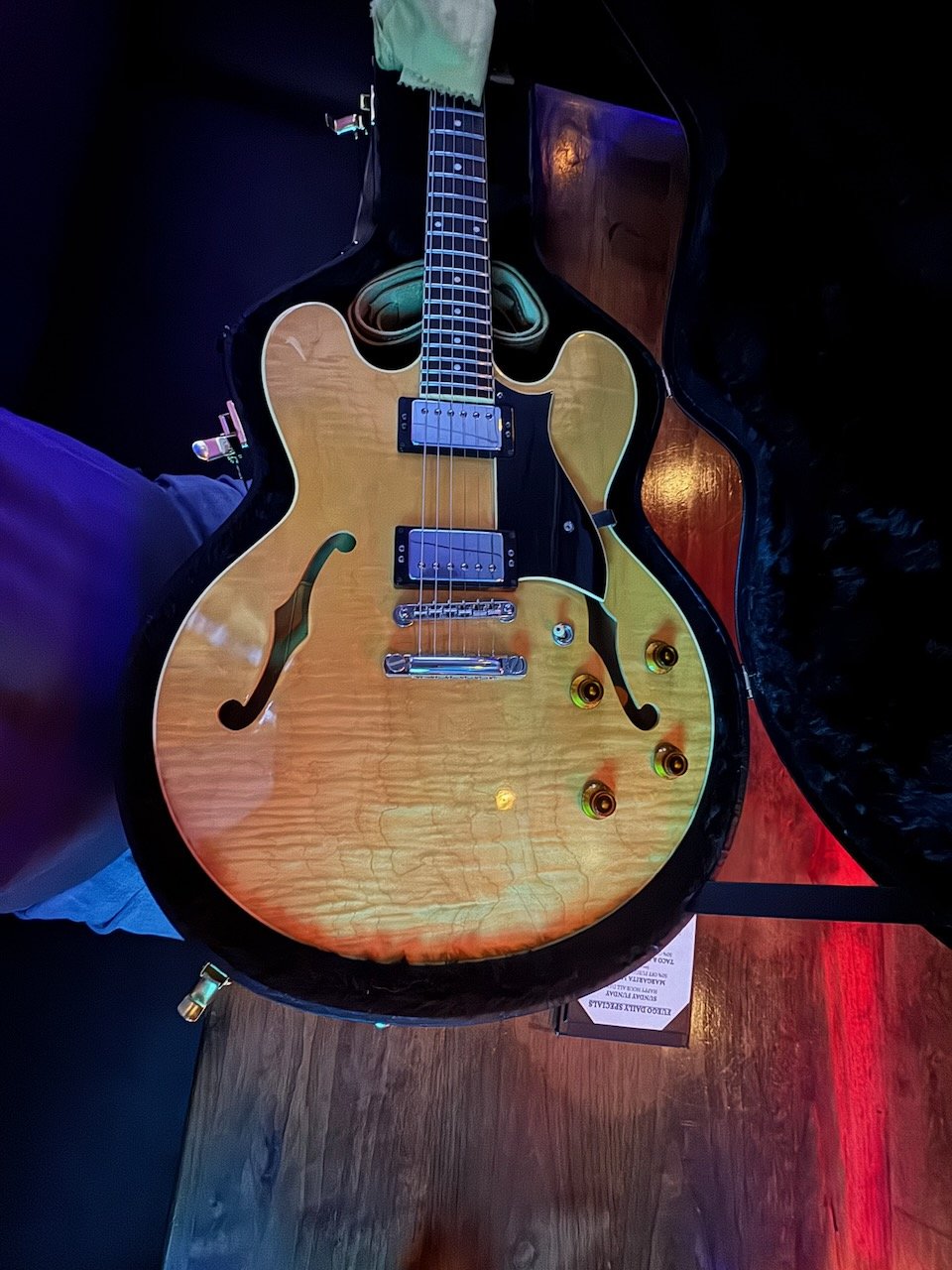
My favorite Heritage and me waiting to go play at a jam. 2001 H535 in blonde, with HRW's. I put the Faber bridge and tail on it, and a set of lightweight Gotoh tuners. The heavy Rotomatics were really stiff from disuse. I got this one used a few years ago. It was absolutely pristine with virtually no sign of play. I picked it up browsing at a guitar shop, wasn't even looking. But it instantly had "the sound" that I look for in a great semi-hollow 535 or 335 style guitar. It had a problem that explained the utter lack of play. The fretboard was like a roller coaster. Some heroic efforts to level the frets on the wavy fretboard had been done to it along its history. Some of the frets were tall as brand new wire, others were under .030 tall, what most of us would call worn out. The fret tops were level, but the board wasn't. The neck itself, straight as an arrow. The surface of the board was nuts. I tried everything I could think of, but just one day said, "this is it." and grabbed my fret puller pliers and took them all out. I put some fine grit paper on my leveling beam and lightly sanded, which revealed all the high and low areas. Pretty much like a lunar landscape it turned out. Also, I measured the radius at around 9.25 inches which kind of meandered up and down the neck. Clearly, this one escaped the factory with a wonky fretboard. The fret nibs were all intact, so no question it was built this way. I leveled the fingerboard and flattened the radius down to about 10". I was already sanding into the pearl dots by then. Didn't want to get into replacing inlays, so I stopped about there. Put in a set of Dunlop medium jumbo wire. With the board leveled out, the frets went in nicely and only needed minimal leveling after installation. I put in a CNC-cut nylon 6/6 nut. Nylon was used on the Gibson's of the late 50's and early 60's. It is a fabulous material for guitar nuts. Hard, durable, and extremely slippery. The Faber hardware went on after. The Schaller stuff was shiny and clean without a single speck of corrosion, but I'm so used to tune-o-matic bridges, I changed it. The most amazing bit of that were the deep bushings Faber offers for their ABR and the tailpiece. They sink much deeper and tighter into the wood and really get in that maple center block a lot better than the short and skinny Schaller bushings. The tone change from the bushings alone was remarkable. And here she is. This is a 100% keeper for life guitar. It's everything a semi-hollow guitar should be. Plays like butter, sings like a bird.

-
My blonde '01 H535 with HRW's. It had an issue when I bought it several years ago. But I pulled the frets and leveled the fingerboard, which was a mess from the factory, and re-fretted it. It always sounded great, and now it plays like a dream. I have a '98 H150 that I picked up and new at first strum, it was a keeper since 25 years ago. That one came with SD '59s and standard tailpiece and Nashville-style bridge from the factory. I've played the heck out of it.
-
All da money in da right hand.
-
So, I'm one of those nerdy engineer types in real life. I've read the Peavey Transtube patents and they're pretty interesting. Sondemeyer was Peavey's chief engineer for decades. Hartley Peavey hired him directly from RCA's solid state division, back in the days when RCA was a giant manufacturer of tubes, transistors, integrated circuits and even microprocessors, as well as a huge maker of TV and other consumer electronics. Sondemeyer was a brilliant engineer. He created many things, including the CS-400 sound reinforcement amplifier. That was the world's first truly bullet proof professional audio amplifier. I still sometimes see these in venues that have probably been in use since the 1970's. Sondemeyer passed away about 10 years ago. I've actually bread-boarded out the original transtube preamp circuits from the patents and the first-generation amps. It is extremely clever, (getting nerdy here) a modified Darlington pair of transistors, and a couple of other tricks, to mimic the characteristics of vacuum tube triodes, like the 12AX7 tube used widely in guitar amps. That generation of guitar amps are actually quite good. Reliable too.
-
Collings makes the I35 in both laminate (ply) and solid top form. The I35 LC is laminate wood, like the ES335, H535. The I35 and I35 Deluxe are carved solid wood. Both are very nice and I've demo'd them in the store side by side. I preferred the LC, but that's likely because I had 335/535 on my mind at the time. YMMV and I might even change my mind depending on what day it happens to be. They're different sounding, even acoustically.
-
My H150 is horny enough. My Les Paul likes to sneak to the naughty websites when no one is looking.
-
Doesn't seem like a, "vs." question to me. I think they work great with either.
-
Yeah, there's no such thing as a, "Dumble". If Dumble didn't make or rebuild it for you, specifically, it's not YOUR Dumble, it will always be the amp Dumble built for the artist he built it for. There are many amps built by Alexander Dumble and they're all different. That's no judgement on the quality of this particular pedal. It might be great. And Mr. Dumble built some pedals too...
-
Well, if you want to go down the deep side of the rabbit hole, I just picked up a used set of ThroBak pickups and installed them in my Gibson custom shop R0 in place of the Custom Bucker 3 p'ups they come with. It is shocking how different they sound than the Custom Buckers and how different they sound than the SD '59 pickups that came stock in my 1998 H150. I measured the inductance, capacitance, field strength and so on, and I have notes on all the pickups I own, including the HRW's in my 2001 H535. Despite being in the range of low-output PAF on every parameter, the ThroBaks are just shocking how bright, clear, harmonic and punchy they are. That goes for the Seth Lovers as well, which are a touch brighter and clearer than the 59's, but man. The only humbuckers in my collection that come close to the ThroBak are the HRW's, but they are a different style of pickup being hotter wound and the bridge especially so. I do know that ThroBak acquired a vintage winding machine from Heritage, that was left over from the Gibson days. ThroBak uses a variety of the same exact winder machines that Gibson used, even some of the actual winders from Gibson. If you know ThroBak at all, it all sounds like absolute hype, but the product performs. I've witnessed hands-on several examples, including my own now. I have no temptation to replace the HRW.
-
I been trying to set hands upon a Morgan Shadow Fuzz. I've heard a couple, but have never had a chance to use one in person. They seem to clean up well, and live on the edge-of-break-up sound really well. Vertex Effects youtube channel has an interview with Just Ostrander, with a really good demo of it. The one I have and really like is a very rare, hand-built Noel pedal, the red one. It isn't really a fuzz, it's a mosfet distortion though. I had an original Fulltone '69 a long, long, time ago. I liked it but found I wasn't using it much. When the price went bonkers on those, I sold it.
-
You know he's an expert pronouncing the name in the original French. 😆
-
Yeah, the thing with Dumble amps is no two are identical. He built each and every one of them for the particular artist. It's not "a" Dumble, in the sense of one Fender Twin Reverb being a member of a large population of such amps produced. It's "your" Dumble if he made it for you. If you buy someone else's Dumble, it's still that artist's Dumble. I've seen the insides of an ODS and a couple of Fenders that Dumble modified. He had some general approaches that evolved over time, but each and every amp he built was a work of art, intended for a particular person to play and tailored to suit that player. He also rebuilt amps when they got sold to a different artist, in fact he recommended that as a way to get the amp quicker, rather than a scratch-build. The Dumble estate and name are being curated by the Dumble preservation association and they're trying to make new ones with the name. I have some doubts, since the man himself isn't around anymore. I hope they can protect his name and reputation though. There are some "clones" of Dumble amps who's schematics have leaked out. ODS #182 is probably the most "cloned".
-
Pickup an old Peavey, even a solid state one. They're cheap as dirt and the better ones with the Black Widow speakers are killer good. Reliable as all get out too. And if you turn your back on it, it will be the only bit of equipment not immediately stolen from the stage. They have that "sound" too, even in gain mode. Heck, there's probably someone somewhere who's been trying to get one out of the garage for years with no takers somewhere. Music Man is another great one, but they seem to have a bit of a following, rarer and command a bit more money. If you're going all out, a Fender ToneMaster Pro and accompanying speaker is great. If you're playing live in modern "no stage volume" venues, they'll love you for it and probably forget whatever guitar you walked in with.
-
To be fair, Schaller made a lot of good pickups. They also made an enormous variety of them too. I think might still be in the pickup business, but they didn't get on board the retail market for end-user pickup swaps. That's driven a lot of growth in the market. I know back in the early 80's when I was a teen, not many of us even knew where the pickups in our guitars came from or who made them. It was sort of the EVH thing that got people talking about DiMarzio and their Distortion Plus. Prior to that, I don't think end-users really considered pickups other than what the manufacturer of the guitar made in house, or bought depending on whether they wanted to invest money in the machinery to make them, or just buy them. Schaller was in the parts business, bridges, hardware, brackets, tuning machines and pickups were just another item in the line catalog. They'd wind up whatever the customer wanted too. Even Gibson had some pickups made by Schaller and many components of pickups they bought from Schaller for their own production. It's pretty simple to make a pickup. The factory Heritage was housed in, certainly made Gibson pickups going to way back when, including the much coveted original PAF's. Heck, a couple of years ago I bought a pair of brand new humbuckers from China, for $14 a pair, including shipping to my house. Honestly, I can't even buy the raw materials and wire for that. They were OK too, nothing special, certainly worked just fine, as advertised. Even included the springs and mounting screws. Like I said, if I didn't like them so much, I'd open those HRW's right up for a look.
-
Yeah the cryo thing was a fad. They did strings too, and fret wire, and probably anything else one could dunk in a dewar full of liquid nitrogen. Liquid nitrogen is pretty cheap actually. My wife's company gets it in the big, self-venting, metal cryo-tanks that are about 5 feet tall for their processes. It's much cheaper than gas cylinders if you're using a lot of nitrogen. You can still buy cryo treated guitar strings, fretwire, and vacuum tubes and who knows what else. Like I said, if you can dunk it, it's been sold as cryo treated. I wouldn't be surprised if someone sells cryo-treated picks. There are changes in metal crystalline and grain structure when they're dunked in liquid nitrogen. I'm not a metallurgist. I'm not sure what effect it would have on alnico. I do know that alnico magnets are used in sensing devices at both high and low temperatures, because they perform well at temperature extremes. That's in the data sheets from magnet manufacturers.
-
I can guarantee the HRW’s in my 535 are absolutely not degaussed. With an electronic gauss meter, they readout on the strong end of the range for alnico 5.
-
I have access to liquid nitrogen at my wife's company. They use it in their 3D metal printing sintering oven to eliminate oxygen during the sintering process. I would be hesitant to dunk a whole pickup in the stuff. I don't think the metal would be harmed, but I think it would embrittle the plastic and damage the solvent cement Schaller used on the bobbins. Also, like I said, the literature indicates that cryo exposure results in a 10% loss in magnetic charge in alnico 5. My HRWs show very good field strength and no lack of charge. Maybe he yanked the magnets, dunked them and then recharged them? Who knows. It wouldn't be a difficult trick to pop out the magnet from a Schaller pickup, dunk it in liquid nitrogen and re-assemble it. Were I going to undertake this procedure in a production environment, I'd order the pickups uncovered from Schaller, and the covers separately in nickel and gold or what not, Then pop out the magnet, do the deed, re-assemble, attach the covers afterward and then wax pot them. If it weren't such a PITA to disassemble them from a semi-hollow 535, I'd pop them out, do all the electrical measurements, and a Bode plot with the exciter coil and integrator on my digital oscilloscope. Here's my post on the subject when I acquired the 535 a few years ago: ^^^ that's someone else's guitar photo in the thread... At the time, I measured the set in my 2001 535 as being quite similar to the Duncan SH-2 "Jazz" set. The other thing that was different are the pots used with the HRW. My 2001 535 had 500K volume and 250k tone pots, with .022uf capacitors. The typical values used with humbuckers are 500k/500k and 0.022uf. My 1998 H150 with factory Duncan 59's in it, had the 300k volume and 100k tone pots, factory from Heritage. Same as used in the Norlin era Gibsons. That made that guitar pretty dark. Until I wore out a pot and replaced them with normal 500k all around. Perhaps some of the "mystique" is picking out a slightly different tone pot. 250k vs 500k for the tone pots would be like rolling the tone knob down to about 7.5 to 8 on a 500k pot when wide open.
-
Greg Koch is a real hoot. Just when I think I figure out something he's doing, he does something else that blow me away.
-
He twangs on some other ones too! Go check out all the videos in the recent guitar selection episodes he’s got going on now.
-
Well, I went and looked at the engineering data for alnico 5 magnets at cryogenic temperature. At liquid nitrogen temperature, the literature says they work in the cold, but there is a permanent 10% loss in magnetization after exposure. There are actual applications of magnets in instruments in cryogenic equipment. Alnico 5 is grain-oriented when cast. While the metal is cast, the cooling process is designed to orient the grains in the direction of intended magnetization. (anisotropic) Not sure what benefit, if any, of cryo treatment. Other than it makes a good story.
-
Put vintage Gibson pickups in my 535 Custom….I like it!!
nuke replied to brentrocks's topic in Heritage Guitars
3 peace neck??? 😁 -
My Gibson R0 with CustomBucker 3 humbuckers have unbalanced coils (per Gibson) and they have a noticeable amount of hum pickup that other Gibson p'ups do not. (and just for fun, I recently yanked out the alnico 3 magnets and replaced them with alnico 2 magnets, which so far I'm happier with) My 2001 H535 with HRW's exhibits no hum, so I don't think the coils are unbalanced. I pulled out the Gauss meter and measured the magnetic field strength and polarization. One of the unusual things about Schaller pickups is the screws are "north" and the slugs are "south" which is the opposite of Gibson and most other humbuckers. The bridge and neck read about the same in terms of strength, and I'd estimate they are alnico 5 and strongly charged, with excellent field strength. Not the highest I've ever seen, but a bit more than most I've measured. The HRW's are definitely made from Schaller components, from the base plates to the covers and bobbin spacing, even the screw threads. But, Schaller could have simply supplied Heritage with the raw components, right down to empty bobbins for Heritage to wind themselves, and loose parts for them to assemble as they see fit. Or they may have supplied them wound or in any other state of partial assembly. I did check the electrical characteristics, the bridge is pretty hot, much higher wind than the neck. I wrote down the inductance and capacitance of the coils and If I didn't like the HRW's so much, I'd open them up. Schaller pickups are very well made. I'm working on several at the moment for a friend doing some restorations on 80's and 90's pointy shredder guitars. I just had one apart to replace the wire with a 5-conductor cable. I had them completely disassembled to clean up the baseplate and solder the ground shield. One characteristic that I've found is they are consistently wound, with very little variance pickup to pickup, and usually have low capacitance windings, so even hotter winds are nice and bright. I tend to wonder if Schaller built their own winders. They were certainly capable of that. If curious, maybe I can snap a picture of a Schaller pickup disassembled for repair.
-
I’ve taken apart and repaired many Schaller humbuckers and there’s nothing special in them. The parts are all metric, and specific to Schaller, so you can’t swap bobbins and magnets, keeper bars and screws and baseplates with US made pickups or parts. They also come with different pole spacing depending on whether they are bridge or neck position. Many other brands are the same spacing for any position even if marked neck and bridge. Even many Chinese manufacturers use the standard US measure components. It isn’t so much you can’t take the magnet out and swap it, it is just you probably won’t be able to get another magnet of the exact same dimensions to fit in the Schaller humbucker. Anything is possible as to what’s in the HRW’s. It is entirely possible they were cryogenically treated. It is also possible that the baseplates, covers, bobbins and magnets were supplied to Heritage unassembled and they wound and assembled them at Heritage. Im happy with the HRW in my 2001 H535. Don’t want to take them apart.