All Activity
- Past hour
-
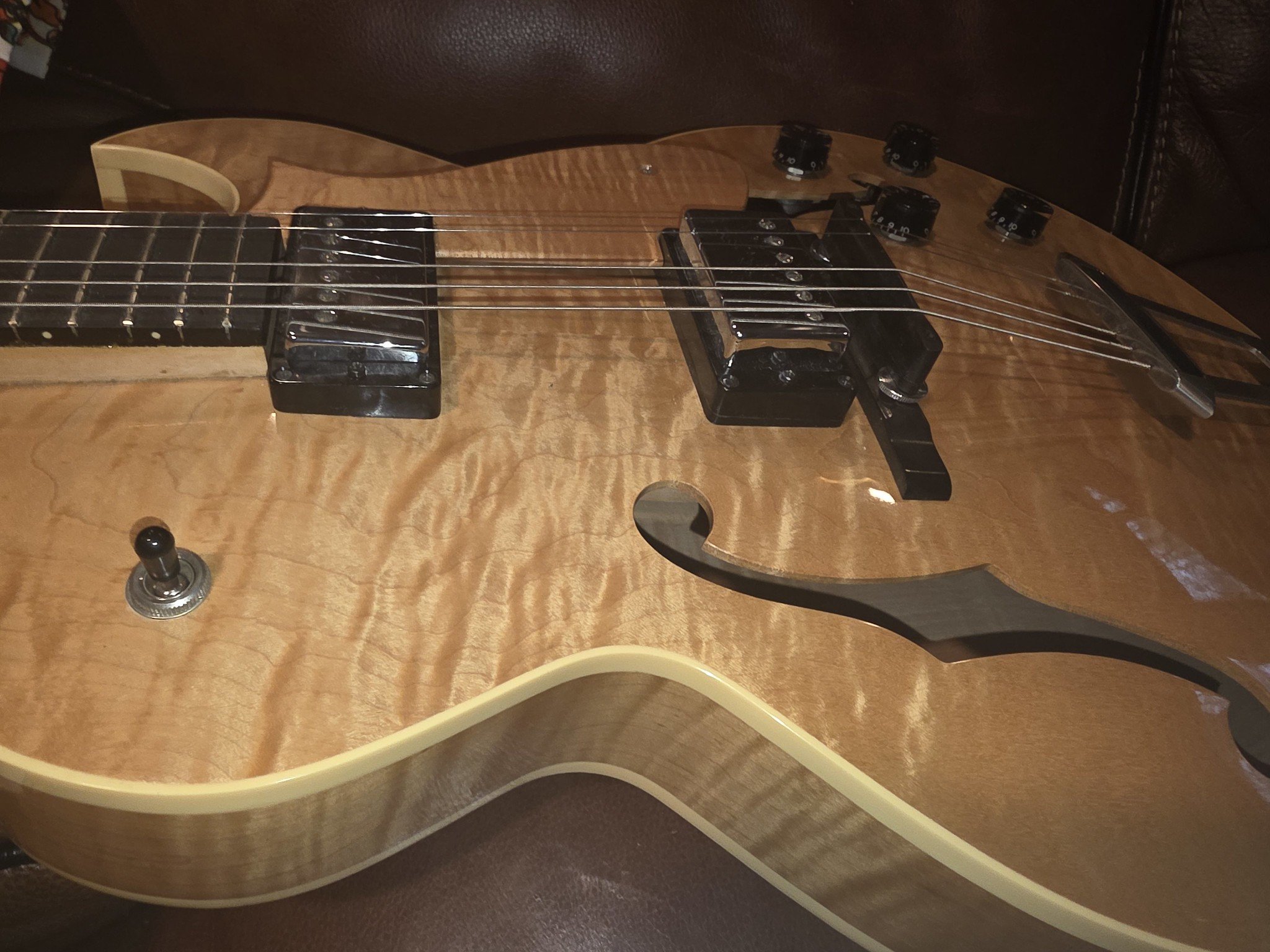
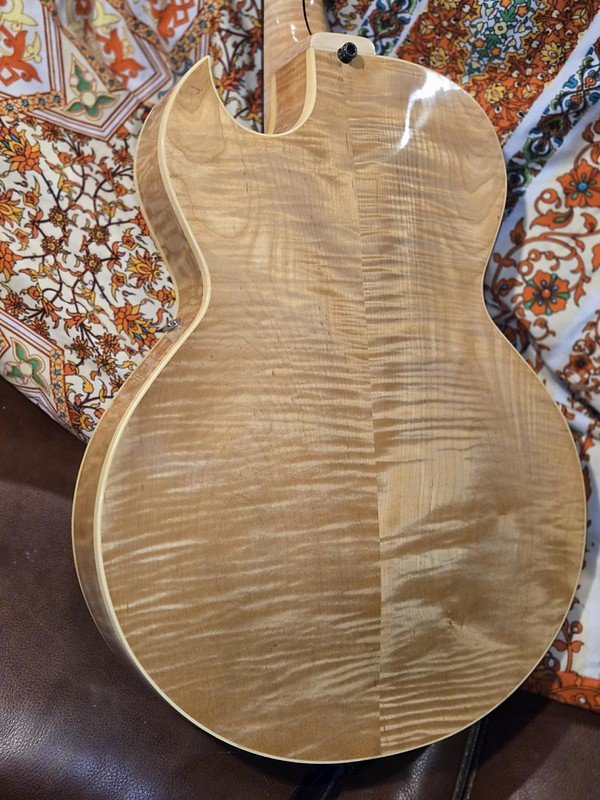
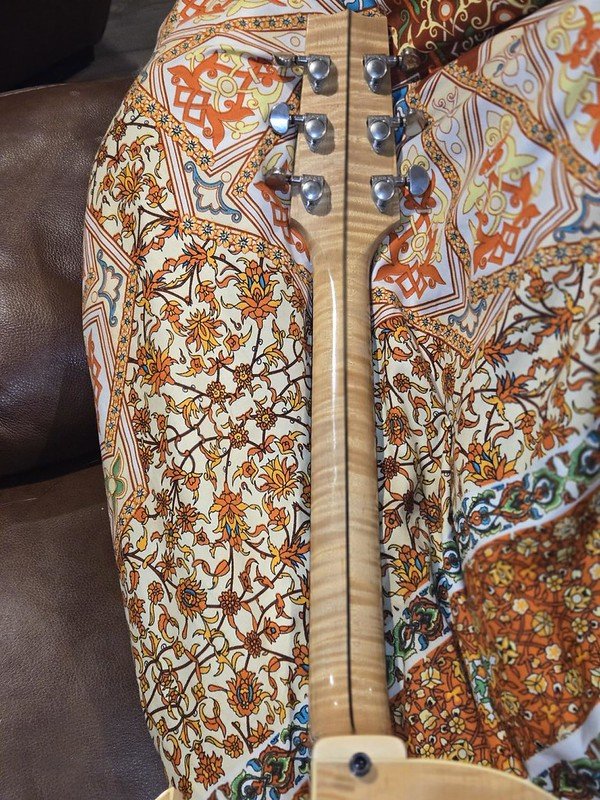
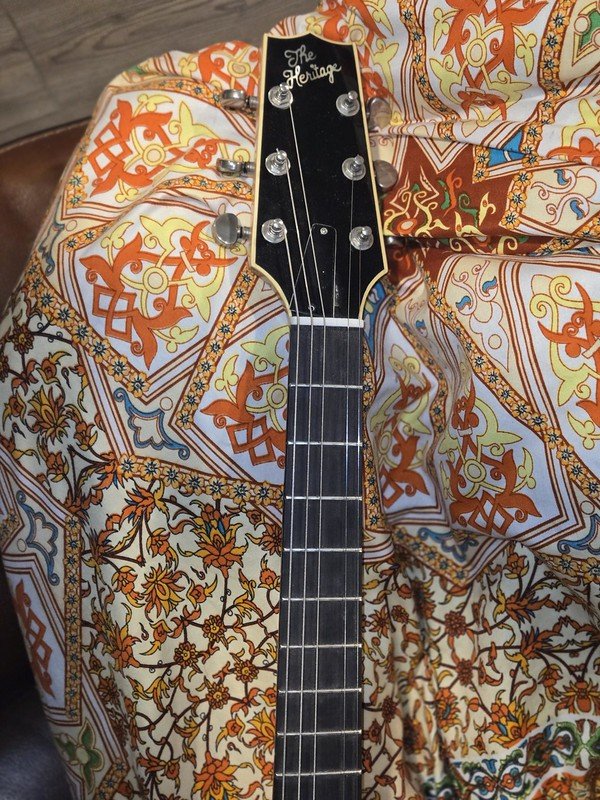
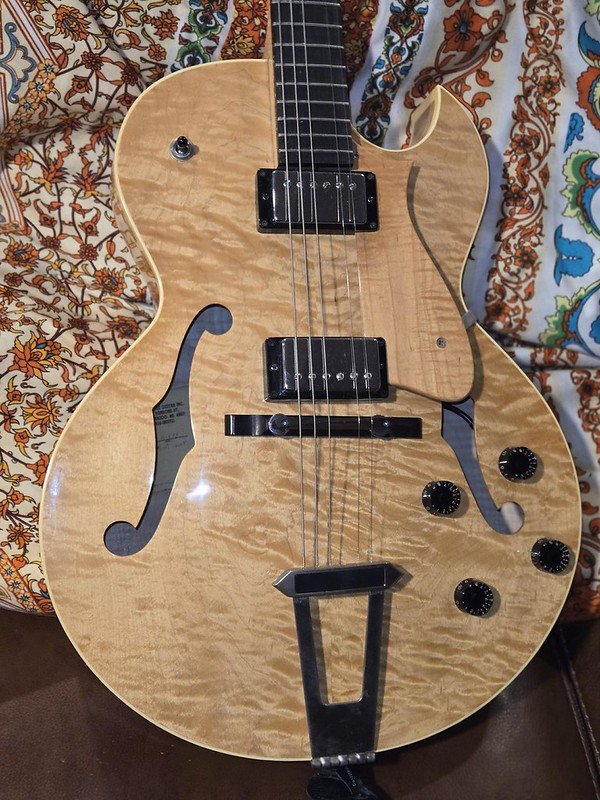
A friend of mine bought a natural 575 from a Guitar Center years ago. When he got it, he found some neck issue that could not be corrected by adjustment. He took it to the legendary Aaron Cowles, who was doing some upscale work for Heritage at the time. Aaron told him the neck needs replacement. I don't recall the details. Aaron did the replacement. Here's an interview with Aaron. https://scholarworks.wmich.edu/gibson-guitar-oral-histories/1/ Aaron died quite a few years ago. I ended up hanging on to the guitar for my friend but didn't play it. Yesterday he sold it to me without ever taking it to his home. If you are feeling sorry for him, consider he has more guitars than anyone else I know. So this is has Schallers. I scoped the innards. It's parallel braced (not all are). Aaron made the neck and but a plain ebony board on it. It's a 3 piece maple. The only piece he got from Heritage is the headstock overlay. My friend requested a five piece neck but Aaron recommended a 3 piece. Aaron fretted it. There are no nibs. That's true with other Aaron builds. Aaron was one of the best of the Kalamazoo luthiers yet a simple man to understand. He always had his pistol handy in shop. He charged very little for his hard work. His humble presentation contradicted his master skills at making guitars and mandolins. The guitar plays well. The neck is to me a medium C carve, maybe a medium plus. It sounds good.

- Today
-
My small experience with Gibson (Memphis and Nashville) has been pretty good. There may have been some rough times in the beginning. Heritage has had its ups and downs but seems quite good the last decade. Most of the earlier guitars also were nicely done. It takes an occasional bad apple that inspires a post on some forum that takes the shine off a reputation.
-

UA enigmatic 82 dumble in a box
DetroitBlues replied to greywolf66's topic in Amplification and Effects
I was thinking of those years in which Jeff was struggling to sleep and started posting some interesting topics and even the chaotic picture of his guitars and amps scattered and upside down... -
Josh, I think JeffB's comments refers to some posts our friend Will (ElNumero) made several years ago about scoring a job as a gate guard at a retirement home in Florida. Or something like that.
-
UA enigmatic 82 dumble in a box
DetroitBlues replied to greywolf66's topic in Amplification and Effects
Are you have bouts of insomnia again? 🤔 I'm still trying to make sense of this.... 😁 -
Please don’t harvest your HRW’s. If it came from Parsons that way, keep it as such. Thank you 🫵🤣🎸
- Yesterday
-
Greg Koch is a real hoot. Just when I think I figure out something he's doing, he does something else that blow me away.
-
Not everyone has the wherewithall to put themselves in a position to rack up those hours on the gate and make the big bucks. More dumbles than I can shake a stick at.
-
UA enigmatic 82 dumble in a box
DetroitBlues replied to greywolf66's topic in Amplification and Effects
No, not everyone has your budget for gear...😁 - Last week
-
Dumble is a Dumble just like a dumbbell is a dumbbell
-
You mean, you never owned a Dumble amp? I thought everybody has.
-

UA enigmatic 82 dumble in a box
Gitfiddler replied to greywolf66's topic in Amplification and Effects
That UA Enigmatic looks like a very cool 'Dumble-In_A-Pedal' device. With its expansive suite of controls it should offer something for any tone-seeking guitarist. That said, I've been very pleased with my original issue Hermida Zendrive pedal, getting me close to Carlton-Ford-Bonomassa tones. Now if only I had their other-worldly playing skills... 🙂 -
Looks really interesting for Carlton, Mayer, Santana tones. Now you’ve got me hunting for a used one on reverb. Dammit!
-
Put vintage Gibson pickups in my 535 Custom….I like it!!
brentrocks replied to brentrocks's topic in Heritage Guitars
Lol -
I’ve been watching. He has a nice H535 as well.
-

UA enigmatic 82 dumble in a box
TalismanRich replied to greywolf66's topic in Amplification and Effects
And which Dumble does it mimic? I thought one of the things about Dumble is that he customized it to match the player. John Meyer's SSS doesn't sound the same as Santana's SSS or Stevie Ray's SSS. Does Larry Carlton's ODS sound like Sonny Landreth's or Robben Ford's? Running an emulator pedal into a guitar amp won't give you a proper model. You should have a full range system like a PA or go into a recording setup which means it's simulating both the amp and the microphone, which is probably it's forte. An ODS fed through a Princeton Reverb or DSL40c probably won't sound much like a Dumble. It might give you a sound you like, but it won't be the real thing. -
It's a shame I'm not working anymore. One of our instruments required liquid nitrogen. We would go by AirLiquide and get a Dewar Flask with about 2 quarts of nitrogen. I could have easily dropped a pickup down there after we finished our testing! We also had a storage tank of liquid CO2 that we used for tank blanketing to minimize fire hazards.
-
He twangs on some other ones too! Go check out all the videos in the recent guitar selection episodes he’s got going on now.
-
Well, I went and looked at the engineering data for alnico 5 magnets at cryogenic temperature. At liquid nitrogen temperature, the literature says they work in the cold, but there is a permanent 10% loss in magnetization after exposure. There are actual applications of magnets in instruments in cryogenic equipment. Alnico 5 is grain-oriented when cast. While the metal is cast, the cooling process is designed to orient the grains in the direction of intended magnetization. (anisotropic) Not sure what benefit, if any, of cryo treatment. Other than it makes a good story.
-
I bought UA’s OX pedal. It’s nothing like their OX Box, which I love. That thing wanted to know everything about me, including social security #, it seemed. I boxed it up & returned it; the o;ly gear I have ever done that to. Love UA analog stuff.
-
https://www.youtube.com/shorts/sia-zcKE0xk
-
UA enigmatic 82 dumble in a box
DetroitBlues replied to greywolf66's topic in Amplification and Effects
Universal Audio makes some great stuff. I use one for all my modulation effects. The one thing though I remember watching from another gear review YouTube channel is when people describe "Dumble-esqe" or sounds like a Dumble, or any Dumble references... There are so few people who actually know what its like to play though one. Everyone claims its Dumble-like, but how many of them actually played a Dumble and had a side-by-side comparison with one? -
Ren wouldn't divulge his secret on HRWs. But I have talked about it with him and with his long-time co-workers. He would only smile when asked about what he did to Schallers. My guess is that they took a bath in liquid nitrogen. I highly doubt he did a partial uncoiling for several reasons. The first is the lack of any hum. The second is that a cryo treatment is an established way to modify a pickup. The third is that cryo treating is clean and relatively easy. Why did Heritage promote the HRW? The best answer I can come up with is because they could, especially is the process is secret. Here is what I got from AI. Cryogenic treatment for guitar pickups involves deep-freezing the components (typically to around or ) to permanently improve their molecular grain structure. Proponents claim this process relieves internal stresses in the metal parts, such as magnets and copper wire, resulting in enhanced clarity, smoother frequency response, and increased output. ProjectGuitar.com +4 Claimed Benefits While controversial in the guitar community, those who offer cryo-treated pickups cite several specific tonal and physical improvements: Enhanced Clarity & Definition: Treating materials like copper and silver is said to improve string definition and provide "faster" transients. Smoother Overtones: The process aims to align the molecular structure to be more uniform, which some makers claim makes overdriven tones smoother and more "in tune" by reducing dissonant overtones. Increased Output: Some manufacturers report measurable increases in output (up to 18%) because the treatment potentially lowers electrical resistance and improves conductivity. "Turbo-Aging": For hardware and magnets, cryo-treatment is often marketed as a way to replicate the "relaxed" feel of vintage parts that have naturally settled over decades. Brands & Services Several high-end and boutique brands incorporate cryogenic treatment into their products: Seymour Duncan: Offers the Zephyr Silver series, which uses cryogenically treated silver wire and magnets for maximum expression and detail. Lindy Fralin / Callaham: Features the Callaham Cryogenic Fralin pickups. Callaham has also been known to offer treatment services for customer-supplied parts. V.I.P. Pickups: Uses a "cryo-tuning" process for their LOVERS PAF-style humbuckers to achieve a more transparent, vintage sound. Faber Guitar: Provides cryogenic treatment for various guitar hardware and components to minimize "bad" overtones. Nitrofreeze: An industrial service provider often used by boutique builders to treat electronic and musical components. Scientific & Practical Considerations Skepticism: Critics often point to a lack of peer-reviewed data supporting tonal claims, suggesting that perceived improvements may be due to psychological factors or "marketing hype". Risk of Damage: Extreme cooling can sometimes cause plastic parts (like bobbins) or adhesives to crack if the process isn't carefully controlled. Metal vs. Wood: While the effect on ferrous metals (steel) is well-documented in industrial settings for hardening, its effect on non-ferrous metals like copper is more debated in the audio world.
-

Put vintage Gibson pickups in my 535 Custom….I like it!!
nuke replied to brentrocks's topic in Heritage Guitars
3 peace neck??? 😁