All Activity
- Past hour
-
I always loved poking through the proto rack. Good to see Arnie and Ted. That spray booth was a blast from the past. Thanks for posting.
- Today
-
Arnie! cool beans DNH. Thanks.
-
Thanks for that Dave. Good times, very good times.
-
With some familiar faces for us old timers.
-
Hey it's almost September.... JNEELY I'm glad you are concerned about Heritage, but you're about 20 years out of date? I'm pretty sure the new owners have the financial means & the business sense to keep it going. All their eggs aren't in one small basket
-
I think this is one of the dumbest posts I've ever read not only that, there's a LEGAL reason they can't use the Gibson shaped horn
-
+1
- Yesterday
-
DB, I won't quote your entire post here. But I'll say this: well said.
-
Oh yes.......that "dreaded hump!" I haven't seen anything like that yet on the newer Custom Shop Core models, but that's been a "dreaded" problem with both Gibson and Heritage for decades. Please correct me if I'm wrong, but I've always held the belief that the longer neck tenons in the reissue Gibsons and newer CC Heritages have mostly resolved that issue.
-
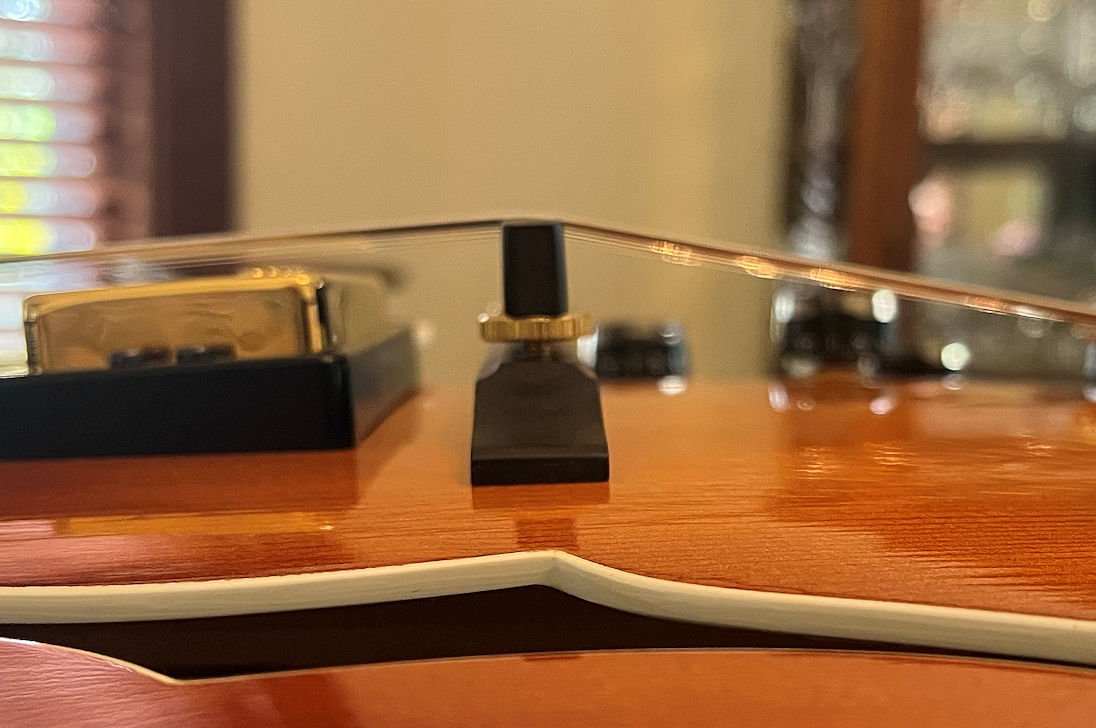
Regarding the bridge, I have a little experience in replacing a similar bridge on an Eagle Classic that I purchased in 1996. In my case, I found that the original bridge posts were simply placed in some drilled holes on the base of the bridge and were not anchored down in any way. I suspect that what we're seeing in the above image is likely the same scenario, for the posts will tend to wobble around a bit in the holes. Whether or not that's the fault of Heritage I won't venture to speculate, but I did replace the original rosewood bridge with a similar ebony model where I was able to screw the posts directly into the bridge base, which resulted in a solid anchoring of the posts. I haven't had a problem with it since. If by chance you're looking to repair your bridge, I would suggest replacing it.

-
I think there are some fair criticisms in here, but I also think you’re drawing some pretty big conclusions from things that are, at best, speculation. First, the QC issues you mention are legitimate. A tuner that isn’t straight and a bridge that isn’t perfectly aligned shouldn’t be dismissed simply because the guitar plays and sounds great. Heritage absolutely has room to improve consistency. But I don’t think it’s reasonable to jump from “I’ve found some fit and finish issues” to “this is why Heritage is struggling,” particularly when you don’t have any insight into their actual manufacturing, financial, sales, or distribution situation. There’s also some important context regarding why Heritage guitars look and feel the way they do. Heritage wasn't created to be PRS. It was essentially born out of the old Gibson/Kalamazoo tradition, with many of the craftsmen, methods and philosophies associated with that factory continuing in a new company. The traditional designs aren't some failure of imagination. They're the product. A lot of players specifically buy a Heritage because they want a hand-built American guitar that carries forward that tradition rather than another company trying to reinvent what a guitar is. And the old factory environment matters. These weren't guitars coming off a modern, climate-controlled, highly automated production line with CNC machines and automated inspection at every stage. You're talking about an old industrial facility, older tooling and a manufacturing philosophy heavily dependent on individual craftsmen. That doesn't excuse a crooked bridge or tuner, but it absolutely provides context for why some of the older guitars can have inconsistencies. More importantly, I think you're overlooking a significant change in the company's history. Heritage changed ownership in 2016 when Plaza Corporation and BandLab became involved, and the company subsequently invested in improving its manufacturing processes, quality and consistency. So if we're going to use individual QC examples to diagnose the company, we also need to recognize that the manufacturing operation isn't frozen in 1985. A lot of the QC issues people associate with older Heritage guitars may very well be considerably less representative of what the company is producing today. That's actually one of the reasons I am cautious about judging Heritages based referencing an older guitar, or even a handful of guitars, as evidence of the current state of the company. I also think calling their innovation an “F-” is a little unfair. If your definition of innovation is “introduce radically new body shapes and designs,” then sure, Heritage isn't trying to win that competition. But innovation doesn't necessarily mean abandoning the thing you're known for. Heritage has taken traditional designs and, in many cases, built them to an extremely high level with features and construction techniques that weren't necessarily present on the guitars that inspired them. That's also why I think the Gibson comparison needs some nuance. Saying they're “just making Gibsons with a different headstock” ignores the fact that the entire heritage of the company is intentionally tied to that lineage. If you don't like that business strategy, that's a perfectly reasonable opinion. But it doesn't necessarily make the strategy a failure. The endorsement and sales-force arguments are more interesting, but those are also largely speculation unless you have actual information about Heritage's sales strategy, dealer agreements, margins, production capacity and the decisions behind particular artist relationships. There may very well have been missed opportunities. I wouldn't argue otherwise. But “they should have signed X artist” and “they should have had a bigger dealer network” doesn't automatically explain their business performance. And honestly, the tone of the post is where I have the biggest issue. You start by saying you absolutely love your Sweet 16 and H-575, acknowledge that they are impressive guitars, acknowledge that the flaws don't prevent you from playing the hell out of them, and then essentially use those same guitars as evidence that Heritage has a fundamental manufacturing problem. It's perfectly legitimate to say, “I love Heritage, but I wish their QC were more consistent.” That's useful criticism. It's a different thing to take a handful of personal observations, add a series of assumptions about endorsements and distribution, give the company an “F-” for innovation, and then confidently declare what is causing their lack of success. That's less constructive criticism and starts to feel a little more like trolling dressed up as a business analysis. Heritage certainly isn't perfect. But there's also value in recognizing that they deliberately chose to preserve a very specific American guitar-making tradition rather than become another company chasing whatever the latest market trend happens to be. And if you're going to criticize the company today, I think it's important to judge the current Heritage, not simply repeat criticisms that may have been much more applicable to the old Heritage. For a lot of Heritage owners, the fact that they stayed true to that Kalamazoo tradition isn't a weakness of the brand...it's the reason we bought one.
-
oops... Eastman
-
Since you insist on going down this road... Let's talk about legality.... Gibson sued Heritage over the body shape.... Namely because the first year of H150's were made from unused Gibson Les Paul bodies. So if you want a Gibson Les Paul body with a Heritage headstock, look for a 1988/1989 H150 (can't remember the exact year of production start) Gibson sued because it was their body design... So Heritage changed it ever so slightly to avoid the lawsuit as well as some other "design" restrictions of the time they had with Heritage. In recent years, when new leaders at Gibson decided to go at just about everyone, including Heritage, most of those restrictions were eliminated thanks to the deep pockets of Bandlab. However, I personally believe the sharp cutaway of the 1st gen H140 was the most "accessible" cutaway for the singlecut, solidbody guitar style.
-
Not my thing but, total respect earned. That’s a very talented guitarist.
-
BTW that's a Collings....
-
Eye roll. Anyway While Im here, check out Tori Slusher.
-
I cant be bothered reading the OP. It just looks like something I might've posted in the early days before I understood how to pace myself. Good luck though.
-
I love my gold top and it is the main guitar I gig with, it is an extension of me. It didn’t come to me without some issues though. The frets were in terrible shape from the factory, the ends looked like a child was let loose on them. The binding was also poorly scraped. There is also the dreaded hump after the 12th fret. Well the guitar is from 2011 and has lots of playing time on it. I’ve filed the frets 3 times now from player wear and there isn’t enough left to do it again so I just bought some new frets. When I pull the old ones I’ll sand down the hump and GT rid of the nibs and hopefully get another 15 years of gigs out of them. The tone of the guitar just can be beat. I think they did a great job on the neck shape and profile and the way it transmits vibrations I think the neck joint must be perfect. The issues were cosmetic and I can live with that since the guitar is the best sounding one I’ve ever owned and there are some lofty brands and models on that list. There is a reason I play it so much. Unfortunately those cosmetic issues, well, many people can’t get past that and assume the rest of the guitar is poorly constructed. Heritage suffered from those cosmetic issues. On the flip side, I bought my guitar in mint condition, just a baby yearling, for a song. Those cosmetic issues don’t payoff for the company but they did for me.
- Last week
-
Paragraphs are your friend. Just saying.
-
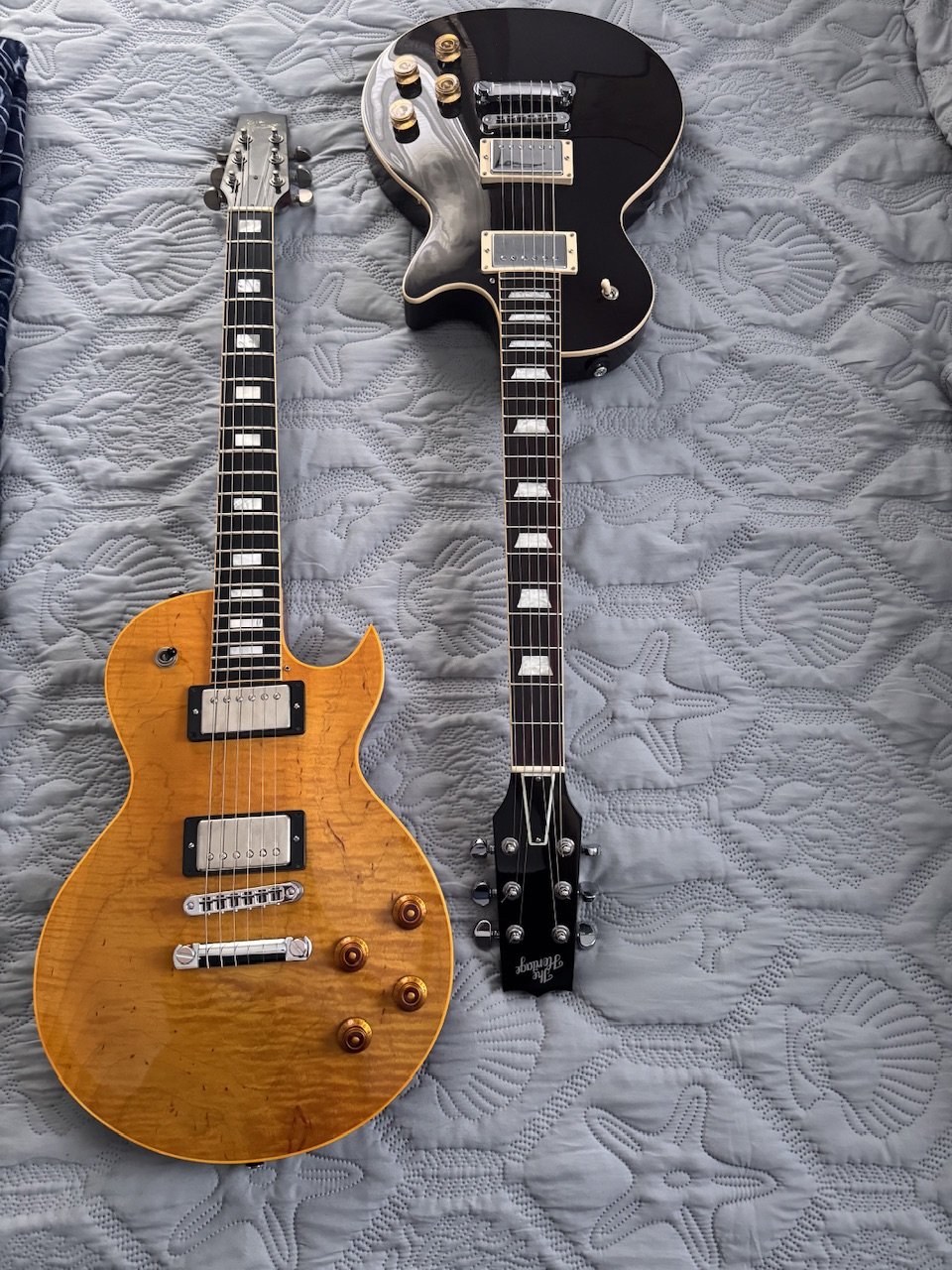
It's funny, I don't see that when I look at a guitar. I see a slim waist and a round bottom.
-
You are really out of touch with today's Heritage Guitars. This isn't 4 old Gibson employees anymore. Two are still alive, two have already passed. Does anyone expect that guys who started working in the late 50s should be building guitars today? These guys are in their 80s. Today, it's a different company. First point about giving them an F for not innovating.... Poppycock. By Jim Deurloo's own admission at PSP last month, when they opened they were making just about anything anyone thought of. Look back at catalogs from 1989 or 1993. Stat, Little One, H-110, SAE and SAE custom, HB1, HB2 and HB IV bass, H-140, Mandolins, banjos, Academy, Prospect, Mark Slaughter, H-574, H-480 acoustic, Parsons Street III and V, Millennium. They tried making unique guitars... they didn't sell. Guitarists wanted the traditional models, 150 and 535 are the bread and butter. The various jazz boxes were well received. I suspect Heritage sells more hollow bodies guitars today than Gibson, who don't even list a traditional jazz box in their current lineup. It's the same reason Fender sells a dozen Strats and a dozen Teles for every Jazzmaster or Jaguar. How many Coronados do you see them sell today? Gibson sells Les Paul, SG and 3xx variants by the truckload. How many Covus, Marauder, Victory or RDs do they sell? They're in the catalog. I don't see many on the Guitar Center wall. As for not having endorsed artists and heavy advertising, that costs money. They simply didn't have the budget to put full page ads in every guitar magazine every month. Perhaps if they had been charging exorbitant prices, they could have bought more ads, but they also might have sold fewer guitars. Gibson, Ibanez, Fender, probably spend more on their annual advertising budget that Heritage made in a year! As for nobody knowing Kenny Burrell, Mimi Fox, or Henry Johnson, you must be looking from a rock perspective. They are well known in the jazz world. Gary Moore had a signature, Alvin Lee did as well. David Paul had the blue jazz box. I've seen Buddy Whittington playing a stock H-140. Alex Skolnick? Having name on the guitar doesn't automatically mean that fans flock to buy them, especially when you have limited production capacity. How many variants of the Stratocaster do you need? Clapton, Beck, Eric Johnson, Jimi Hendrix, Yngwie Malmsteen, Jimmy Vaughn, Stevie Ray, Robert Cray, Cory Wong, Rory Gallagher. That's just part of the artist models. The same goes for Les Paul variants. Reinvent the wheel.. .over and over and over again. Finally, I think you are looking at past history. Today, you can find Heritage guitars at Wolfe, Daves, Eddies, Sweetwater, Chicago Music Exc, Cream City, Jimmy Wallace. That's just the bigger US dealers selling US made guitars. They have an import line, akin to Epiphone, Fender Mexico, Squire or PRS SE. It's not to everyone's liking, but its brand building. And having played samples of the Ascent+ guitars, they actually played quite well. I would have no problem walking on a stage with an Ascent+ 150 or 137. Heritage is doing just fine. They are shipping out guitars by the dozen, not 2 or 3 a week. It's a different company.
-
I’m not sure I’m sold on the idea. Here’s the beauty of being in America: We all can form our own ideas AND we’re free to go out and start our own guitar company.
-
Yeah, it's the horn that's going to make or break a guitar. You simply can't play a guitar if the horn doesn't have the exact dimensions of that someone drew up 70 years ago and endorsed by a Youtube personality. Sorry, I don't get your point other than trying to start a pissing match. Oh yeah, that horn of which you speak has changed numerous times over the years at that "other company". Personally, I think it's the silly poker chip that is holding back the Les Paul player from being successful. Seriously, if the stupid guitar player has to stop, look down at the front of his guitar and decide if he's playing rhythm or "treble", he needs to find another occupation. Speaking of which, how exactly do you play "treble"? Does that mean you can only use the notes on the treble clef?
-
The early 150's had the same horn and Heritage was asked to change it. If your next post is about the headstock, it works better and Heritage was not sued over it. Most of us on the HOC appreciate function over form.
-
I had that same issue on my 575 and that was on an aftermarket saddle and bridge. It was resolved with a second curly washer bottoming out on each of the studs. What is happening in that photo is "rocking torque" That is not a good thing. It needs to be corrected.












.thumb.jpeg.965e47b2f1a04648fe32581941f80da4.jpeg)